Advantages for Active Sukuk Investment Management
Key Takeaways
- A sukuk index may not be broadly diversified in practice. Market-cap weighting can concentrate exposure in the largest issuers while giving smaller eligible issuers limited influence on portfolio composition.
- Cap-weighted benchmarks can translate debt issuance into higher portfolio exposure — regardless of whether that incremental debt offers the most attractive credit or relative-value opportunity.
- Active management allows selective participation in fast-growing new supply. Rather than absorbing newly issued debt mechanically as it enters an index, an active manager can determine whether, when, and how much exposure to add.
- Index Concentration: Most sukuk benchmarks are highly concentrated. It’s not unusual to find five or six issuers represent over one-third to over half the index by weight.
If a Sukuk Index Already “tracks the market,” why would I Need an Active Manager?
It’s a fair question. Buying a bond index fund usually means getting broad, automatic diversification — a large, established market spread across thousands of borrowers, with no single name able to move the needle much. That assumption holds up well in markets like US Treasuries or investment-grade US corporate bonds.
The US dollar sukuk market presents a different set of considerations. Although the global sukuk market is well established, with more than $1.0 trillion outstanding at year-end 2025, it remains relatively small compared with larger and more mature markets, such as the US Treasury market. As a result, applying the same analytical framework used for those markets may not be appropriate.
In a market characterized by structural nuances, cultural considerations, and regional specialization, a purely mechanical, formula-based approach may not be optimal. Two features of sukuk index construction illustrate why an active investment approach can add value.
Concentration is convenient for building an index — not for managing risk
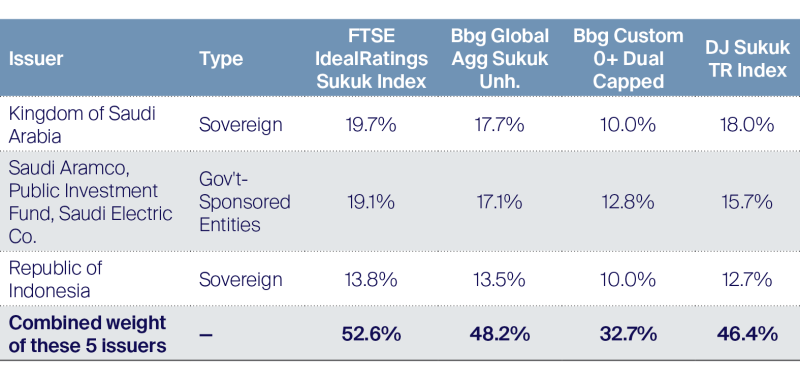
In US dollar sukuk benchmarks today, just five issuers — the Kingdom of Saudi Arabia, three Saudi government-sponsored entities, and the Republic of Indonesia — account for roughly a third to over half of three widely used indices.
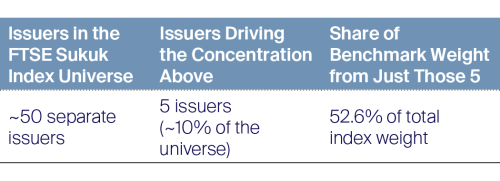
That kind of concentration may be convenient for index construction, but from a risk-management standpoint it means investors are effectively making a very large allocation to a handful of names, while leaving a rich, diversified opportunity set under-represented. The scale of that mismatch becomes clearer when placed against the size of the opportunity set itself. The FTSE Sukuk Index universe includes nearly fifty separate issuers — yet the five issuers above, barely 10% of that universe, represent more than half of the benchmark’s total weight.
A benchmark built this way sorely underrepresents the breadth of the market it claims to track. Roughly 90% of eligible issuers are left to share less than half the total index weight between them.
The way benchmarks are built can reward leverage, not strength
Most sukuk indices weight constituents by the market value of outstanding sukuk — essentially a market-cap weighting. In fixed income, that can lead to owning more of the frequent and largest issuers, which are often the most indebted. Unlike equities, where a larger market cap may reflect success, in bonds a larger outstanding size can simply mean more leverage, so a cap-weighted approach can unintentionally overweight the most leveraged issuers.
Saudi Arabia provides a relevant example. In recent years, the country has been an active issuer of both conventional debt and sukuk. More than 80% of the outstanding debt issued by Saudi Arabian corporate issuers was issued during the past three years. Similarly, nearly two-thirds of the outstanding debt of Saudi government-sponsored entities (GSEs) at year-end 2025 had been issued during the preceding five years, compared with just over 50% measured over the prior three-year period.
Saudi Arabia’s recent issuance activity illustrates how quickly this concentration can build. The following analysis shows the total outstanding stock of conventional debt and sukuk issued over the trailing three- and five-year periods ending in 2025.
An active approach lets a manager step back from that mechanical exposure, evaluate the credit fundamentals and policy trajectory behind it, and decide how much risk to take in those segments versus other high-quality issuers across the GCC and beyond.

Advantages of Active Management in the Sukuk Market
In short, active management gives an investor the ability to diversify away from benchmark concentration, avoid simply lending the most to the most indebted, and build a more balanced sukuk portfolio than a pure index-tracking approach would allow.
Diversification by choice, not formula. Avoids the concentrated, few-issuer exposure built automatically into cap-weighted benchmarks.
Credit quality over debt quantity. Evaluates issuers on creditworthiness, not simply on how much debt they’ve issued.
Discretion over fast-moving new supply. Can pace exposure to newly issued debt rather than absorbing it automatically as it’s added to an index.
Coverage for rating gaps. Able to apply independent research to issuers a benchmark simply labels “non-rated.”
Redirection toward quality, not just size. Steps back from mechanical index exposure to weigh credit fundamentals and policy trajectory, and to decide how much risk to take in a given segment versus other high-quality issuers across the GCC and beyond.