Higher Rates, for Mostly Good Reasons
Key Market Takeaways
- The economy has been stronger than we expected. Earnings are growing at the fastest pace outside a post-recession recovery since the late 1980s, valuations are less stretched than a year ago, and this year’s rise in rates has come mostly through real yields, consistent with stronger growth rather than higher inflation expectations.
- For those reasons, we are not bearish on equities. This year’s gains have come from earnings, not from investors paying more for them.
- The risks are slower-moving: tightening cycles have usually preceded recessions, with a long lag; the artificial intelligence (AI) buildout increasingly depends on outside capital that higher rates make more expensive; and a handful of companies drive the index. We favor high-quality companies with low debt that fund growth from their own cash flow.
The third quarter established that the economy has been stronger than we expected. In March we worried that high energy prices would slow growth. Instead, September’s flash composite purchasing managers’ index (PMI), a survey of business activity, reached a 62-month high of 58.4, and payrolls rebounded by 162,000 in August after a soft summer.
That strength carried stocks through a difficult quarter. The calm we described in June as “contingent rather than guaranteed” did not hold. Fighting with Iran resumed and pushed oil above $100 a barrel, the Federal Reserve (Fed) began raising rates, and the 10-year Treasury yield reached its highest level since 2002. The S&P 500 still gained 2.4% for the quarter (12.7% for the year).
The better kind of rate rise
The rise in interest rates is mostly for good reason. Of the 10-year yield’s 111-basis-point rise this year, 100 came from real yields, and market-based inflation expectations rose just 11 basis points. As the Cleveland Fed’s president put it, “it’s real rates that have moved up more than the inflation expectations.” Chair Warsh offered three reasons for higher long-term yields: “First is economic strength… Second reason, competition for capital… The third is geopolitics.”
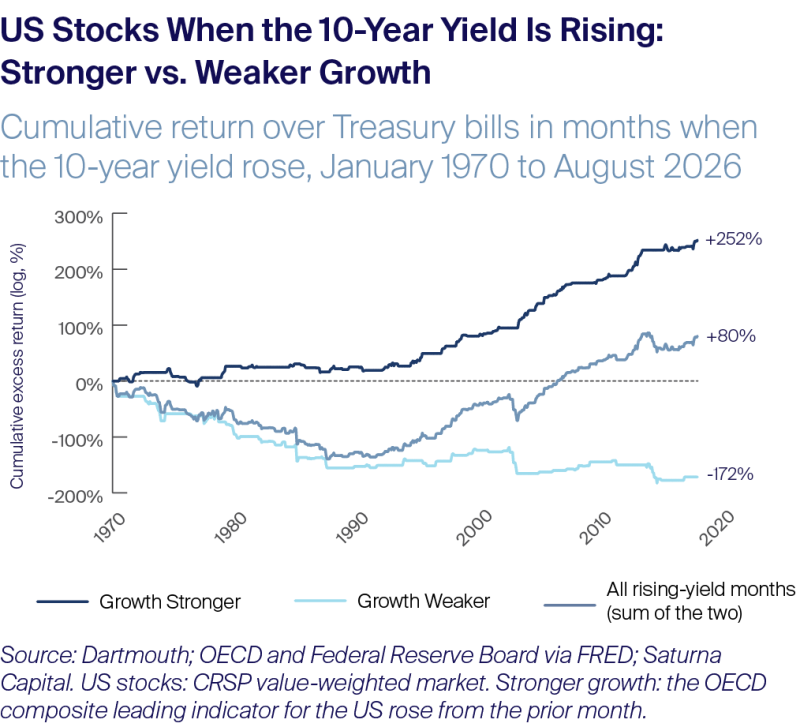
The distinction matters for stocks. When yields rise because the economy is growing, earnings tend to grow too, which helps offset the higher rates used to value them. When yields rise on inflation fears, the Fed can be forced to keep tightening, despite a weaker underlying economy. Since 1970, in months when the 10-year yield rose and an Organisation for Economic Co-operation and Development (OECD) leading indicator of US growth was also rising, US stocks beat Treasury bills by an annualized 18%. When US growth was falling, the market trailed Treasury bills by about 14%. That indicator has risen for 15 straight months, through August.
Earnings and valuations
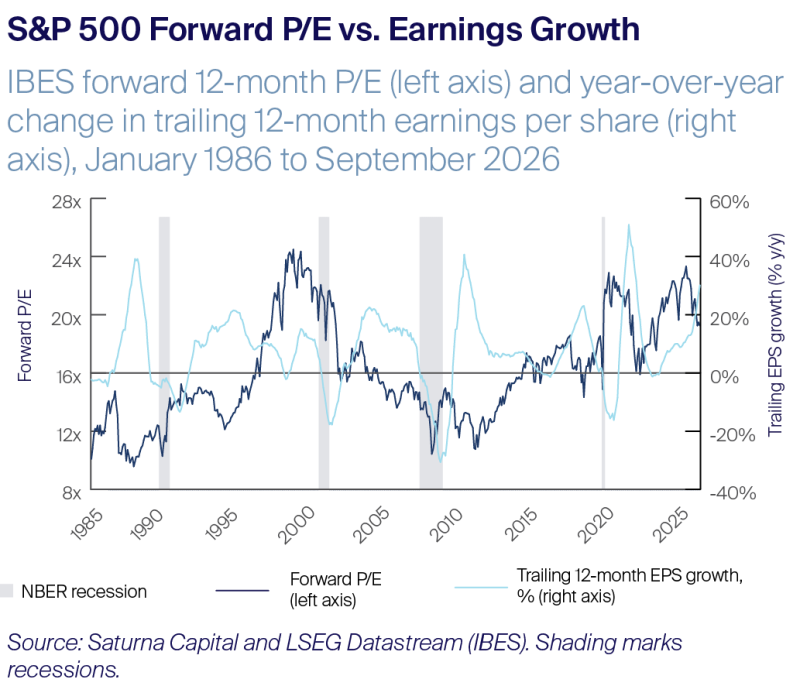
This macroeconomic strength has manifest in equities, with S&P 500 earnings up 30% over the past four quarters, driving the strongest growth outside of a post-recession recovery since the late 1980s. With earnings expectations outrunning prices, valuations are less stretched. For example, the S&P 500’s forward price-to-earnings (P/E) ratio has fallen from about 23 a year ago to 19, in line with the index’s 10-year average. This combination of strong fundamentals and reasonable valuations keeps us constructive on equities.
What keeps us measured
Despite solid fundamentals, we remain alert to potential rogue swells. The Fed raised rates in September for the first time since 2023, and most officials expect at least one more increase this year. Tightening eventually creates risk, but the lag can be long. Of the last 12 tightening cycles since the mid-1960s, eight were followed by recession at a median of 28 months after the first hike.
The artificial intelligence (AI) trade also gets more complicated from here, as the buildout increasingly runs on outside capital. New borrowing has risen from 9% of hyperscaler capital spending in 2024 to about a third over the past year. In June, Alphabet announced an $85 billion equity raise, and Oracle sold about $20 billion of stock in the three months through August, with others likely to follow. With the 10-year above 5%, that capital costs more and may become harder to raise.
Headwinds also grow as the investment cycle matures. Hyperscaler capital spending is on track for about $800 billion this year (+94% from 2025). As that growth slows, rising depreciation expenses could offset nearly half of AI spending’s boost to S&P 500 earnings growth next year, and all of it by 2028. Interest on new debt and dilution from new shares add to the bill.
As a final measure of caution, the market remains heavily concentrated, with seven companies making up about a third of the S&P 500. Beyond weights, market breadth is also narrow and the median stock is approximately 15% below its 52-week high, the widest gap with the index since the dot-com era.
Outlook
The expansion looks sturdier than it did in the spring, but the Fed is likely to raise rates further, the AI buildout’s depreciation and financing bills will come due, and the federal government will have to address its deficit spending addiction at some point. In that environment, quality, low leverage, and strong cash flow should matter more, not less. Quality companies have historically managed growth-driven rate increases well. Therefore, our preference remains resilient companies with low debt that fund growth from their own cash flow, a distinction that matters more with the 10-year above 5%.